
I’ve spent more time than I care to admit working with, for, and alongside nonprofit boards. And I’ve eaten more than my share of board lunches and dinners. LOL. After many years, here are three possible ingredients to add to the lunch or dinner menu for your next board meeting.
Consider the View from the Balcony
When I’m hiking a trail in the midst of a forest or wondering if we’re making progress towards our strategic plan, perspective is important. In our leadership programs, we often refer to this concept as part of adaptive leadership and the difference between being on the dance floor and up in the balcony observing.
This is why it’s important to take some time to reflect on where we have been, where we are going, and what progress has been made. This is also why it can be helpful to get some third-party support for some of that needed perspective (ALERT: Support Center offers free office hours for just such an occasion). But for boards, that might mean asking: where were we three years ago, where are we now, and where are we going? This can relate to board composition and diversity, the structure of the board and its functioning, or even the effectiveness of meetings. But sometimes gaining valuable perspective and focusing on where we want to get to is critical.
Think Developmentally and Compassionately
The work of governance is inherently a group exercise that relates back to the functioning of a group of decision-makers. It’s often long, messy, ambiguous, slow-moving. This work in particular requires moving together, showing vulnerability and being compassionate. It reminds me of the adage that if you want to go quickly, go alone. If you want to go far, go together.
This is also the place where the thinking around transitions and nonprofit lifecycles is incredibly important. Often board work is fundamentally about change management, and there are frameworks that can help us to understand how we are feeling and what we are experiencing during times of transition.
Diversity and Inclusion Aren’t Just Buzzwords in the Boardroom
The graphic below is taken from work by BoardSource (Leading With Intent 2021) looking at the intersection of race and racial diversity and board composition. We can see that only about a third of responding organizations place a high priority on recruiting board members from the community or with direct knowledge of the community. I would hope that every organization would make this a high priority in their recruiting efforts.
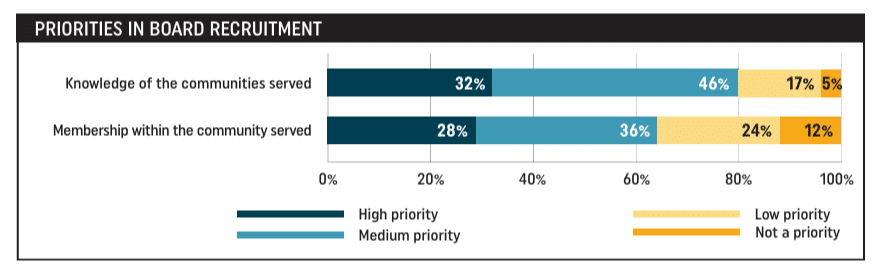
Of the many nonprofit places and spaces that I work in, the boardroom often has the most barriers. But I also believe in my heart of hearts that creating inclusive and accessible and meaningful board opportunities for new perspectives—Black and brown people, young people, differently abled people, people from different economic backgrounds—is some of the most important diversity, equity, inclusion, and belonging work that we can do.
And are there more ingredients to work with in the board kitchen? Of course! We haven’t really talked about the role of data and reporting or how the board is structured. But these three ingredients are a great place to start. And if you want to talk more about the ingredients in your board kitchen, drop me a line at kt****@*****************ne.org.